Hasbro Writes Down $56m as It Narrows Its Games Plan
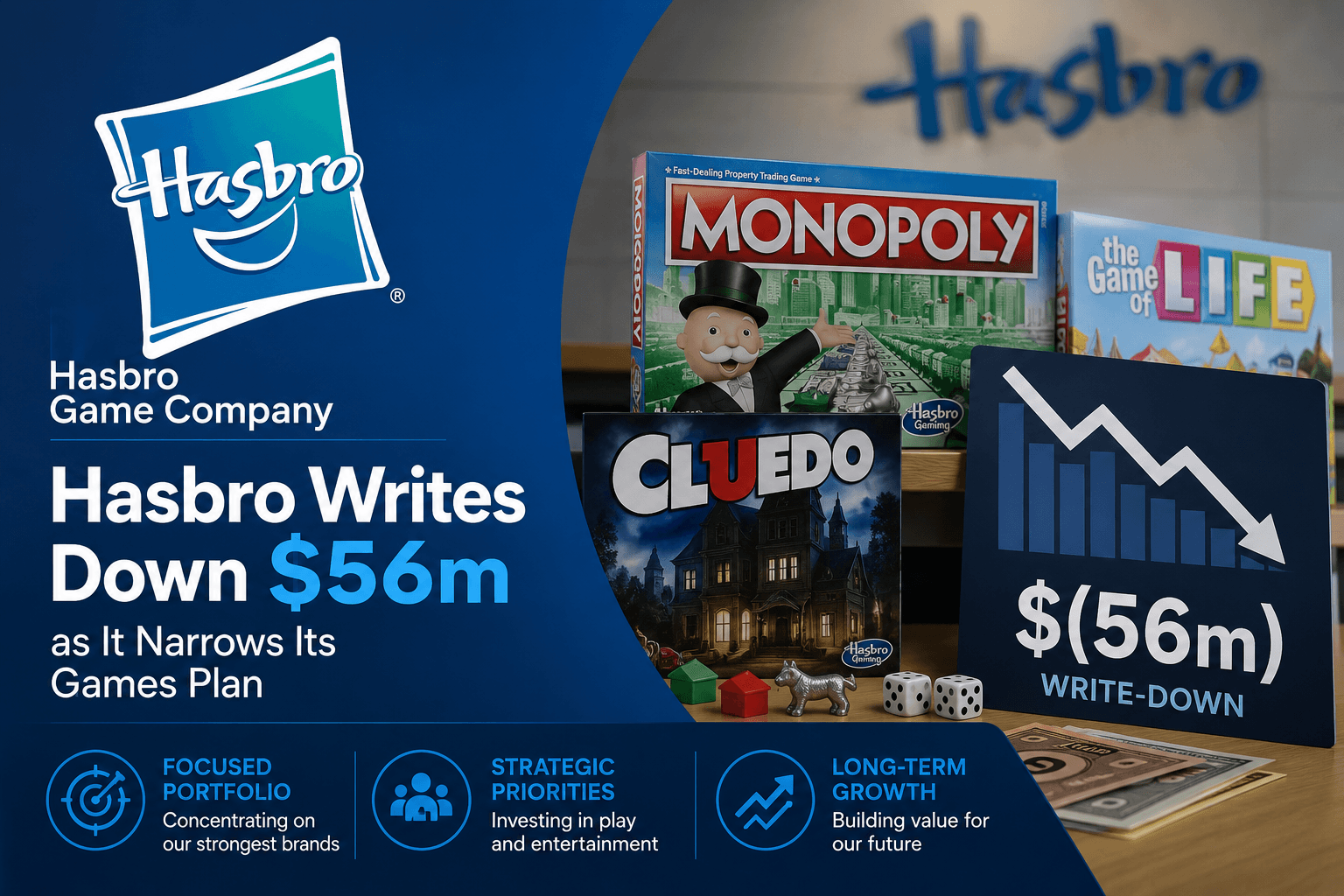
Hasbro has officially recorded a $56 million non-cash impairment charge after reviewing and refocusing its Digital Games portfolio for 2028 and beyond. The confirmed move was disclosed in the company’s second-quarter 2026 results, while chief executive Chris Cocks subsequently said the review had resulted in several game cancellations. This matters well beyond Hasbro’s balance sheet: one of gaming’s biggest IP holders is now making fewer long-range bets at precisely the point publishers are weighing up the cost of the next console generation.
Importantly, this is not Hasbro abandoning games. Its Wizards of the Coast and Digital Gaming division grew revenue by 27 per cent year on year in the first half of 2026, while digital and licensed gaming revenue rose 10 per cent across that same period. The write-down instead signals a sharper distinction between projects Hasbro believes can become major franchises and those that no longer meet its commercial or strategic threshold. The affected games have not been named.
A Confirmed Reset, Not a Retreat
The company’s results make clear that the impairment is tied to capitalised costs from projects originally planned for 2028 and later. On its earnings call, Cocks said Hasbro had cancelled several of those games as part of the portfolio review. That is a meaningful clarification, but it does not validate online speculation around particular studios, licences or announced projects. Hasbro has not published a project-by-project list, nor has it explained how many teams or developers may be affected.
Hasbro’s new priorities are focus, cost discipline, ownable platforms and partnership. In practical terms, the company is putting greater weight behind trading card games and role-playing games, where it sees a stronger advantage through Magic: The Gathering, Dungeons & Dragons and its existing digital ecosystem. For genres outside those strengths, Hasbro appears more willing to work with external partners rather than build every capability internally. That is a deliberate change in how it wants to turn famous brands into games.
The Growth Story Is Still Wizards and Partners
The timing of the reset is striking because Hasbro’s broader games business is performing well. Magic: The Gathering led the division’s quarterly growth, while Monopoly Go! generated $44 million during the second quarter alone. Hasbro is therefore not cutting back because digital gaming has stopped mattering to the company. Rather, it is concentrating investment on areas with proven demand, familiar operating models and clearer routes from tabletop communities to ongoing digital spending.
That caution also sits alongside wider pressure on the business. Hasbro said tariff expense affected Consumer Products, while an unauthorised network access incident identified in late March disrupted operations during the quarter. The company estimated direct incremental costs from the incident at $11 million across the first half of 2026, alongside an approximate $25 million revenue impact. Against that backdrop, trimming expensive, distant and less certain game projects is a logical defensive move.
What This Means for PS6
The PS6 is not on the market, and nothing in Hasbro’s announcement amounts to a PlayStation 6 game reveal. Still, the implications are relevant to Sony’s next-generation planning. Console makers need a steady stream of ambitious third-party games to make new hardware feel essential, especially when development budgets keep climbing. Hasbro owns some exceptionally valuable worlds, but this reset suggests that not every previously imagined AAA adaptation will survive long enough to compete for shelf space on a future PlayStation platform.
For players, a smaller Hasbro slate could be better if it means more coherent projects with the right studios attached. A focused Dungeons & Dragons RPG or a carefully handled Magic experience has more potential than a rushed wave of genre experiments built solely around recognisable branding. For PlayStation, the opportunity is in securing strong partnerships around the projects that remain, while recognising that major IP owners are increasingly choosing selective, lower-risk pipelines over sheer volume.
A More Disciplined Route to Console Games
Hasbro’s decision is another reminder that the next era of console gaming will not be defined only by hardware power. It will also be shaped by which publishers can afford to fund multi-year development, which franchises can support premium releases, and which projects are compelling enough to survive internal scrutiny. Hasbro has confirmed that its 2028 pipeline is getting smaller, not that its games ambitions are disappearing. Its next test is whether the remaining bets, including its 2027 releases, justify that harder line.
What We Know
- Hasbro recorded a $56 million non-cash impairment charge in Q2 2026 related to its refocused Digital Games portfolio for 2028 and beyond.
- Chief executive Chris Cocks said Hasbro cancelled several games scheduled for 2028 and beyond during its portfolio review.
- Hasbro did not identify the cancelled games in its earnings release or public earnings-call remarks.
- Wizards of the Coast and Digital Gaming revenue rose 27 per cent year on year in the first half of 2026, while digital and licensed gaming rose 10 per cent.
- Hasbro has continued to publicly target 2027 for Exodus and Warlock: Dungeons & Dragons.
What Remains Unclear
- Which individual projects were cancelled and how much development had been completed on each one.
- Whether any internal studios, external partners or jobs will be directly affected by the cancelled projects.
- Whether Hasbro will announce additional console games after its current 2027 releases.
- Whether any future Hasbro projects will be developed for PlayStation 6, which has not launched.