FSR Next vs PSSR: The Next-Gen Upscaling Battle
The next PlayStation and Xbox generation is unlikely to be decided by raw shader counts alone. Sony and Microsoft are both investing in machine-learning-assisted graphics, with AMD sitting at the centre of both roadmaps.
Microsoft has officially described Project Helix as a custom AMD platform co-designed for the next generation of DirectX and FSR. Sony’s upgraded PSSR is already connected to its long-term Project Amethyst work with AMD. That makes the future of reconstruction one of the most important PS6 graphics stories to follow.
What Upscaling Does
A game does not always render every pixel at the display’s final resolution. Instead, it can render internally at a lower resolution and use an algorithm to reconstruct a sharper output. The benefit is that the GPU spends less time producing raw pixels, leaving more performance for lighting, geometry, simulation or higher frame rates.
The difficult part is maintaining detail during movement. Thin foliage, hair, particles, reflections and objects crossing the screen can expose errors in temporal reconstruction. Better machine-learning models aim to reduce ghosting, shimmer and unstable edges while preserving the look of a higher-resolution image.
What Sony Has Confirmed About PSSR
Sony describes PSSR as an AI library that analyses game images pixel by pixel while upscaling them. In February 2026, PlayStation announced an upgraded version that changed both the neural network and the wider algorithm, with the technology first used in Resident Evil Requiem on PS5 Pro. Sony’s official explanation says the updated system is connected to Project Amethyst and AMD’s FSR 4 work.
That does not confirm the exact PSSR version or hardware implementation that PS6 will use. It does show that Sony is treating reconstruction as a platform technology rather than a one-off PS5 Pro feature. The current PS5 Pro rollout gives developers experience with the technique before a future console can build more dedicated machine-learning capability into its silicon.
What Xbox Has Confirmed About FSR Next
Microsoft’s official Project Helix announcement says the console is being developed with AMD around next-generation DirectX and FSR. It also promises a major increase in ray-tracing performance and intelligence integrated into the graphics and compute pipeline. Xbox Wire does not publish a final FSR version, chip specification or retail performance target.
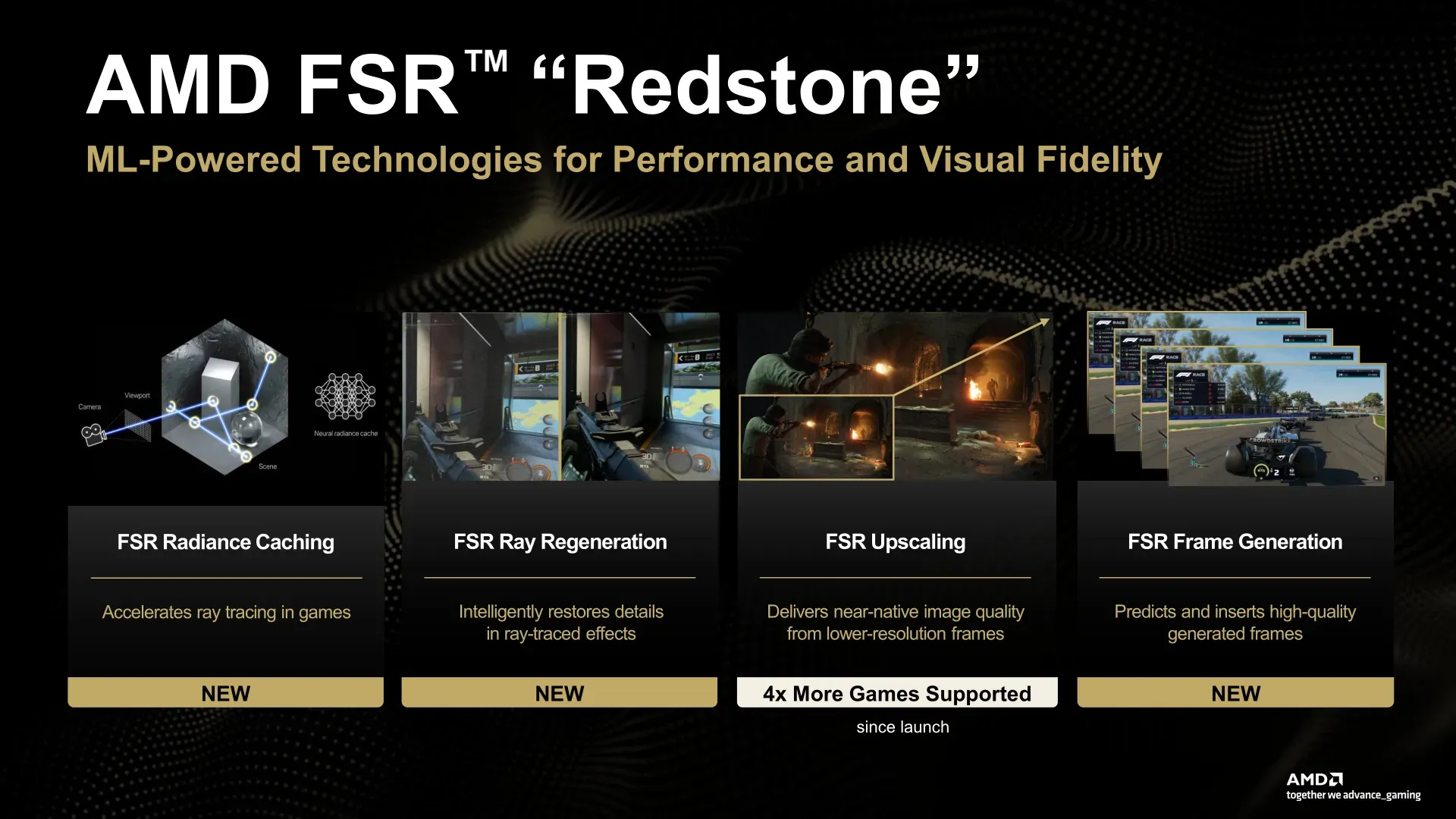
AMD’s current public material shows the direction of travel. Its FSR technology now includes machine-learning upscaling, frame generation, ray regeneration and radiance caching, although PC implementation and future console implementation should not be treated as identical. AMD’s technical overview is useful evidence of the underlying technology, not confirmation of a Helix shipping feature list.
Upscaling Is Not the Same as Frame Generation
Upscaling reconstructs the existing game frame at a higher output resolution. Frame generation creates additional frames between traditionally rendered frames. Both can make a game appear smoother, but they solve different problems and place different demands on latency, motion prediction and image stability.
A future PS6 or Helix could use both techniques together, but a high displayed frame rate would not automatically mean the same level of controller responsiveness as a natively rendered frame rate. Developers still need a strong base frame rate, good motion data and careful tuning. This is why the next generation’s graphics story will be about the complete pipeline rather than a single branded feature.
What This Could Mean for PS6
The strongest inference is that PS6 games may rely more heavily on reconstruction to balance ray tracing, larger worlds and higher output resolutions. Sony’s Project Amethyst work could give PlayStation developers a more mature neural-rendering stack, while Microsoft’s Helix strategy could benefit from AMD’s broader FSR and DirectX integration.
Neither company has confirmed that one system will produce better images in every game. The real comparison will depend on developer tools, training data, motion-vector quality, hardware acceleration and how much freedom studios have to target different performance modes. For now, PSSR and FSR Next are best understood as competing directions within a wider AMD-linked shift towards machine-learning graphics.