PS6-Era Graphics Patent Could Cut Game Install Sizes
Sony Interactive Entertainment has published a continuation patent application for storing game textures in leaner on-disk formats before converting them back into a graphics format the GPU can read. The technique could reduce part of a game’s installation footprint without requiring a future console’s graphics processor to understand an entirely new texture format.
Application US 2026/0340878 A1 was filed on 7 July 2026 and published on 29 October. It builds on a Sony patent family dating to August 2023, so this is fresh legal activity around an established graphics-compression project—not proof that Sony invented the method this week or has selected it for PlayStation 6.
The PS6 relevance is practical rather than confirmed. Higher-detail worlds need more texture data, while console SSD capacity, download sizes and memory bandwidth remain constrained. A better storage format could ease part of that pressure, but the filing provides no whole-game tests, no PS6 implementation and no promised saving for players.
What Sony’s New Continuation Covers
The application is titled “Rate-distortion-optimization via bit-rate reduction”. Sony Interactive Entertainment LLC is the applicant, Thomas Madams is the named inventor, and the document contains 20 claims. It continues US application 18/448,137, filed on 10 August 2023.
That parent application became US patent 12,725,311 on 1 September 2026. The new continuation pursues another claim set within the same technical family. A continuation is not a product announcement, and its publication does not mean the latest claims have been granted.
The central idea is to choose a storage-only representation for texture blocks using rate-distortion optimisation. In plain English, software weighs the amount of space saved against the image error introduced, then selects a leaner block only when the trade-off meets the chosen quality target.
How BC7 Texture Compression Normally Works
Textures are the images wrapped around 3D objects and environments. BC7 divides texture data into four-by-four-pixel blocks and stores colour endpoints plus interpolation indices that describe how each pixel blends between those colours. Microsoft’s BC7 documentation identifies it as a Direct3D block-compression format designed for good RGB image quality with relatively few artefacts.
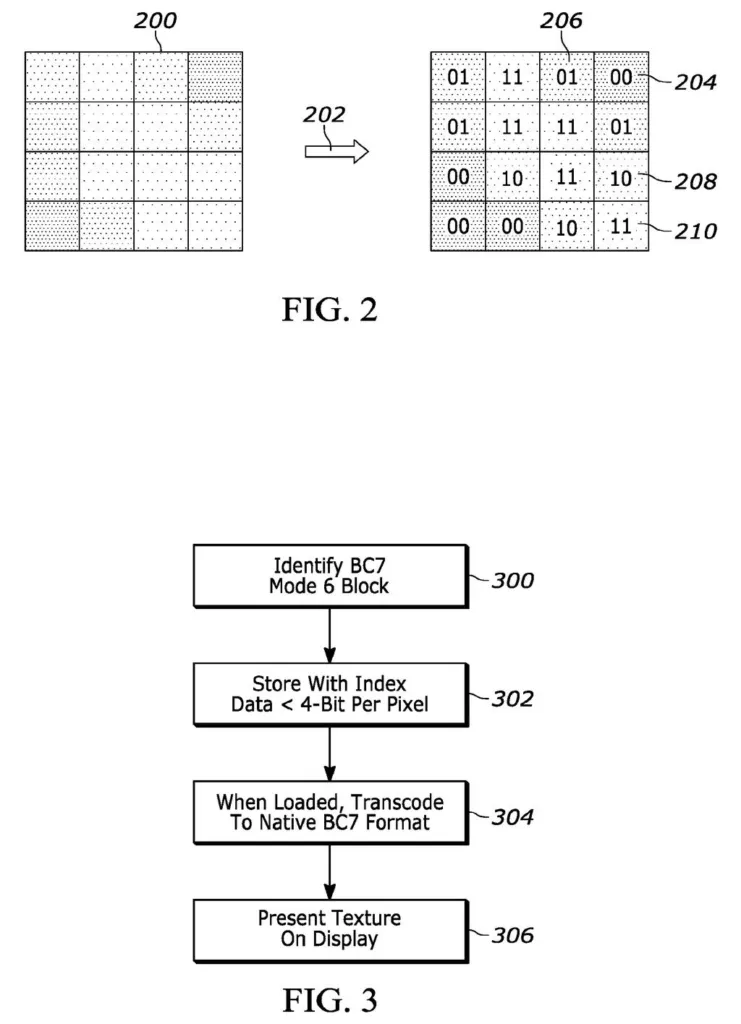
A standard BC7 block occupies 128 bits. In the mode highlighted by Sony’s filing, each of the 16 pixels receives a four-bit interpolation index. That precision is useful for difficult blocks, but the patent argues that many blocks do not need all four bits to remain acceptably close to the source image.
Sony’s approach can either post-process an existing BC7 texture or encode original pixels directly into one of the slimmer storage modes. Direct encoding matters because the fresh continuation’s claims focus on choosing the reduced precision while creating the stored block, rather than always making a full-size BC7 block first.
The Four Storage Modes Explained
The description gives several storage-only options. A conventional BC7 block remains at 128 bits. Reducing the interpolation indices to three bits produces a 112-bit block; two-bit indices produce 96 bits; and one-bit indices produce 80 bits. A fourth mode lowers both index and endpoint-colour precision and can reach 64 bits for suitable opaque blocks.
When a reduced block is needed for rendering, its shorter indices are remapped to values compatible with standard BC7 mode 6 or mode 7. The GPU therefore receives a familiar native format. The conversion back to standard BC7 does not add another lossy step, although precision was already discarded when the smaller storage block was created.
Extra metadata is still required. The filing describes one flag bit per block to identify whether it uses a reduced mode, plus additional bits to identify which reduced format applies. Some blocks would remain at the full 128 bits because lowering their precision would create too much error.
Why This Does Not Make a Whole Game 50% Smaller
The most aggressive example cuts an individual texture block from 128 bits to 64 bits, but that is not a claim that a 200GB game becomes 100GB. A game also contains geometry, audio, animation, executable code, cinematics, language packs and many other files. Even within the texture set, only blocks that satisfy the quality rule would use the smallest mode.
The real result would depend on the content. Large areas with simple colour transitions may compress well, while detailed surfaces, transparency and fine material variation may need more precision. Metadata and file-system overhead also reduce the theoretical saving. Sony supplies block layouts, not a benchmark from a shipping title.
The defensible conclusion is narrower: the method creates more size options between a full BC7 block and a heavily reduced one. Across millions of suitable texture blocks, those incremental savings could become meaningful, but no public evidence establishes an average percentage for PS6 games.
What It Could Mean for PS6 Storage and Graphics
Our PS6 SSD and storage guide explains why capacity and data movement matter alongside peak drive speed. A fast SSD can feed assets quickly, but compression determines how much data must be downloaded, stored and moved before the GPU can use it. Smaller texture files could leave more room for games and reduce the bandwidth consumed while loading high-detail assets.
The technique also strengthens the wider PS6 graphics story without being another upscaling system. PSSR reconstructs displayed images, frame generation creates additional temporal samples, and ray-tracing research changes lighting. This patent instead targets the representation of texture data before rendering begins.
A future handheld could benefit for the same reason. Portable systems face tighter storage, memory, power and thermal limits, so reducing data movement can be valuable. That is an inference, not confirmation that this filing belongs to the rumoured PlayStation handheld described in our PS6 Jupiter handheld console rumours guide.
How It Differs From Universal Compression
Sony and AMD’s Project Amethyst research has discussed Universal Compression as a future way to reduce traffic across more of the graphics pipeline. That concept primarily concerns data moving through memory and the GPU during real-time rendering. Sony’s BC7 patent is more specific: it stores selected texture blocks in reduced formats and transcodes them when they are loaded.
The two ideas could theoretically complement each other. Leaner files could reduce installation and storage pressure, while broader real-time compression could reduce memory bandwidth during rendering. Neither relationship nor a PS6 implementation has been confirmed, so combining them into a finished architecture remains an informed possibility rather than a disclosed specification.
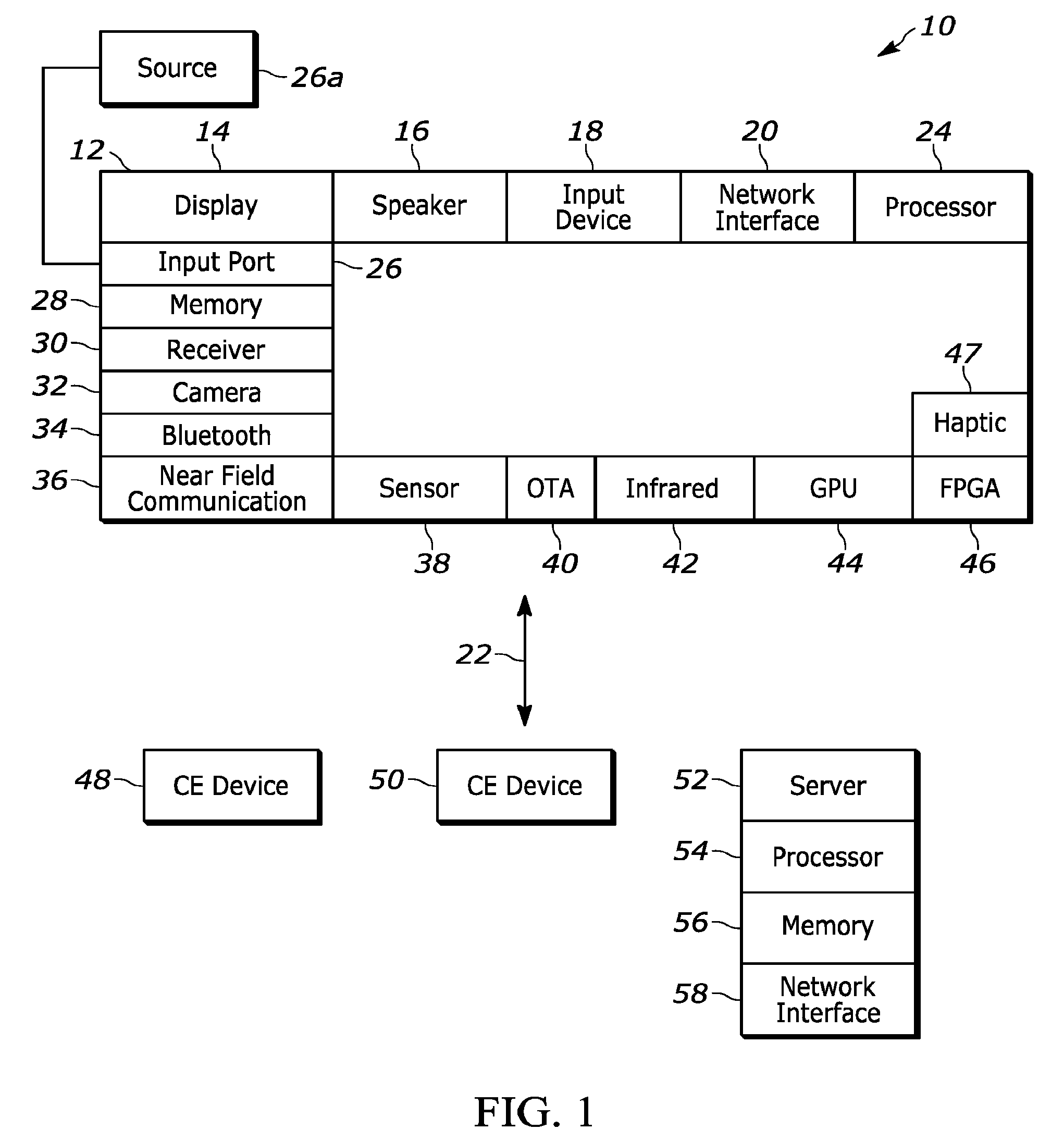
The use of a Direct3D texture format also means the method is not inherently restricted to one PlayStation box. The filing’s broader description refers to PlayStation, Microsoft and Nintendo consoles among possible computing devices. Microsoft’s PC-facing platform direction, covered in our Xbox Helix DirectX guide, makes standard graphics formats strategically important across the next console generation.
What Is Confirmed — And What Is Not
Confirmed: Sony Interactive Entertainment owns the patent family; the parent patent was granted on 1 September 2026; the continuation was filed on 7 July and published on 29 October; and the documents describe 128-bit BC7 blocks being represented in several smaller storage-only modes before transcoding to GPU-native BC7.
Not confirmed: use in PS6, a PS6 handheld, PS5 updates, specific games or development tools. Sony has not disclosed real-world installation savings, image-quality results, processing costs, loading-time changes or whether publishers would need to build the encoder into their asset pipelines.
The next meaningful evidence would be a Sony developer presentation, SDK documentation, a shipping game that identifies the technique, or measured texture and install-size results. Until then, the patent is a credible piece of Sony’s future graphics research—not a promise that every PS6 game will occupy half the space.