PS6 Frame Generation Patent Uses Controller Input
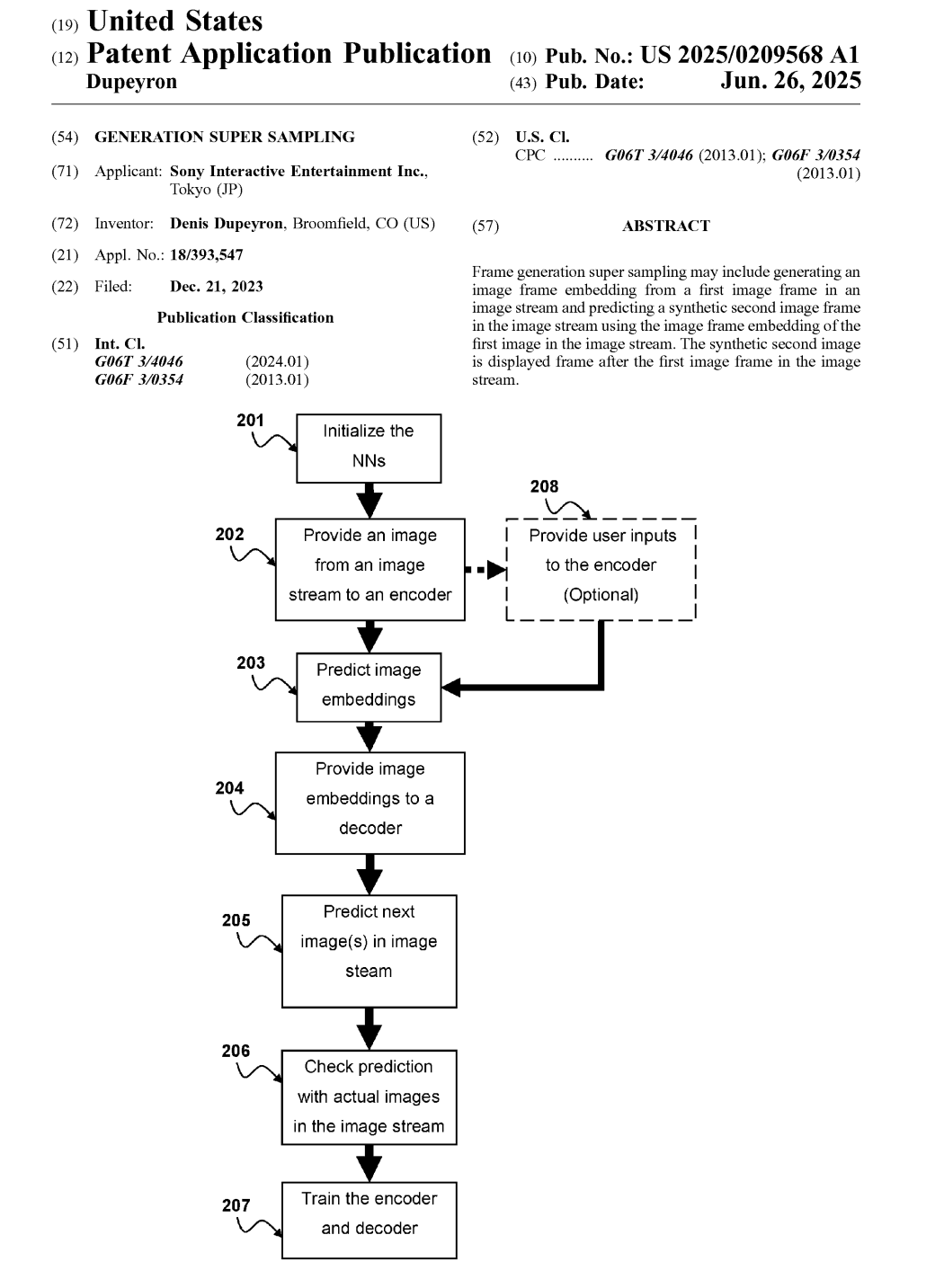
Sony Interactive Entertainment has published a fresh continuation patent application for Generation Super Sampling, an AI-assisted frame-generation system that can use recent controller input to help predict what the player will see next. The idea is unusually relevant to future PlayStation hardware because it tackles one of frame generation’s hardest problems: adding visual smoothness without waiting for two fully rendered frames.
The application, US 2026/0320740 A1, was filed on 23 June 2026 and published on 15 October 2026. It continues a patent family dating back to December 2023; an earlier US application was published in June 2025 and has since become US patent 12,749,147. The new document therefore expands an established Sony research trail rather than revealing a technology invented this month.
There is no confirmation that Generation Super Sampling will ship with PS6, appear under that name, or form part of PSSR. Patents protect engineering ideas and do not guarantee commercial use. What makes this one worth watching is the specific method it describes and how closely its goals align with the wider direction of PS6 graphics research.
What Sony’s New Patent Application Covers
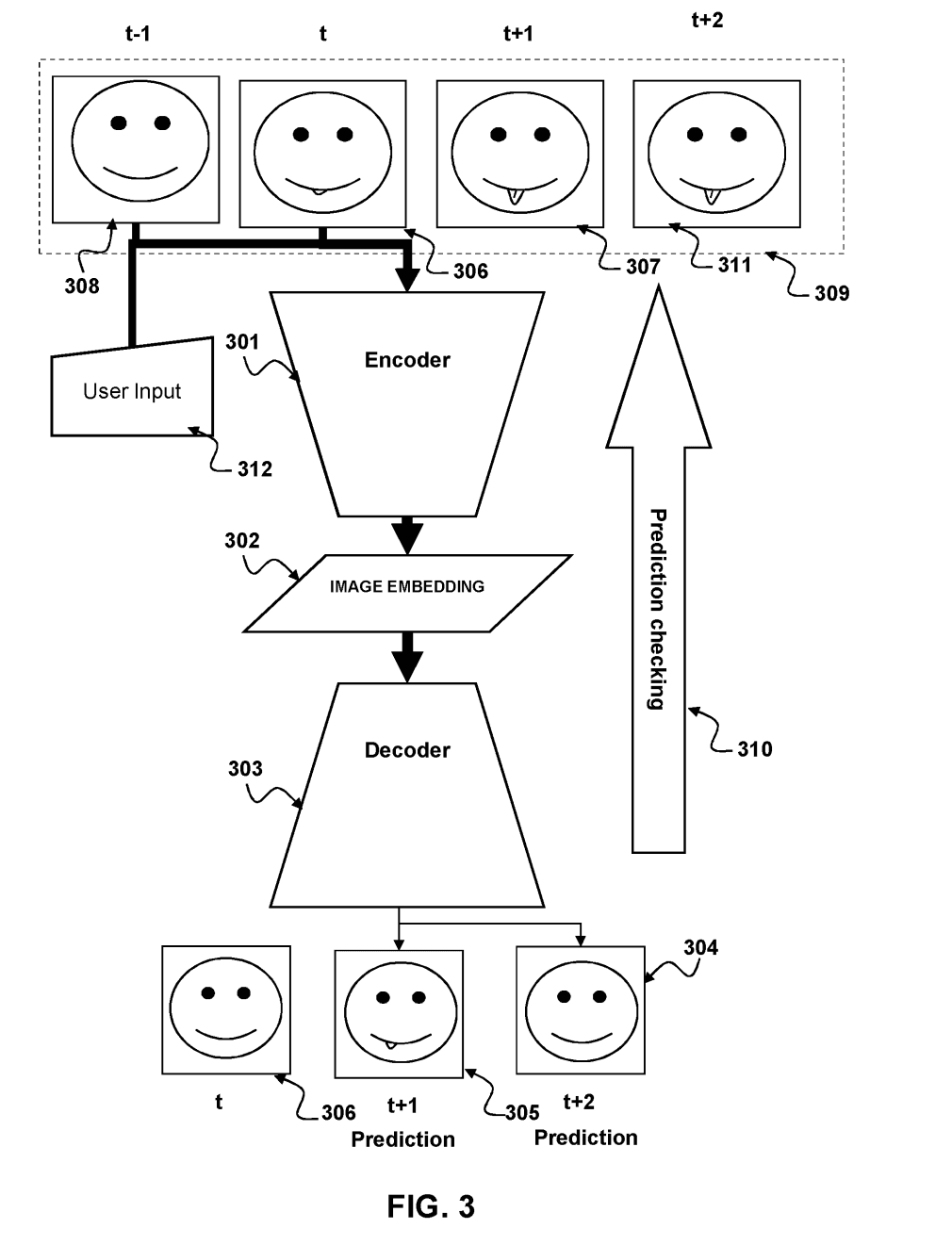
The published continuation application describes an encoder-and-decoder neural network. The encoder turns a real image frame into a compact image embedding, while the decoder uses that information to predict one or more later images. Those synthetic images can be displayed after the latest real frame and before the graphics pipeline finishes the next real one.
Sony’s examples allow the encoder to receive more than pixels alone. Motion vectors can describe where objects are already travelling, while an earlier frame can provide temporal context. In optional implementations, recent user input is supplied as another signal. The filing also describes a non-neural, algorithmic route that moves blocks of pixels according to motion vectors.
The claims in the continuation focus heavily on the training process and neural-network arrangement. Claim 6 explicitly covers providing user input to the encoder before it predicts an image embedding. That matters because a controller can reveal intended movement before the result becomes visible in a completed frame.
Why Controller Input Could Improve Prediction
Conventional visual prediction must infer what is about to happen from images and motion data. That works well when movement is already established, but it is harder when the player abruptly jumps, turns the camera or changes direction. The previous image cannot show an action that has not yet happened.
Controller data offers an earlier clue. Sony’s filing gives the example of a player pressing the jump button: the model could learn that the next few frames are likely to contain a jump animation. It also lists button presses, movement information, joysticks and inertial measurement units as possible inputs. The patent says those inputs may be made contemporaneously with a frame or shortly before it.
This does not mean a future PlayStation would simply turn a button press into a guessed screenshot. The controller signal would be combined with visual information, learned image embeddings and potentially motion vectors. Its value is as an extra piece of evidence that can reduce ambiguity when the on-screen scene is about to change.
Prediction Is Different From Two-Frame Interpolation
Many familiar frame-generation systems interpolate between two conventionally rendered frames. Once both real frames exist, the system estimates an intermediate image and inserts it between them. That approach can deliver a much higher displayed frame rate, but waiting for the later real frame adds to the latency chain.
Sony’s proposal can instead extrapolate forward from the latest available information. The synthetic frame may be created and shown before the next real frame has been generated by the conventional graphics pipeline. The earlier granted Sony patent states that the predicted image can appear after the first real frame and before the second real frame exists.
That distinction is the core of the filing. Interpolation asks what happened between two known states; forward prediction asks what is likely to happen next. Prediction can remove a wait, but it also gives the model a more difficult problem because the future is not yet known.
The Potential Latency Advantage
If the prediction is fast enough, Sony’s system could add visible frames without making the display wait for a second completed render. That offers a route to smoother motion while avoiding part of the latency penalty associated with techniques that depend on two real frames. Controller input may further narrow the gap between the player’s action and the predicted visual response.
The patent also discusses maintaining a steadier displayed cadence when the underlying rendering workload varies. A difficult scene might take longer to render conventionally, yet one or more synthetic frames could fill part of the interval. For a console, that could be useful when a game prioritises richer lighting, ray tracing or a higher internal image quality.
However, the filing includes no measured reduction in milliseconds, no target base frame rate and no image-quality comparison. It would be inaccurate to claim that the method eliminates input lag. A generated frame changes what the display shows; it does not make the game simulate physics, process AI or update collisions more frequently.
What Could Go Wrong With Predictive Frames
Predicting a future image introduces obvious failure cases. A model may anticipate the wrong animation, miss an unexpected object, distort fine geometry or invent detail that does not agree with the next real frame. Rapid camera movement, particles, transparent effects and disoccluded surfaces are already difficult areas for frame-generation systems.
Controller input helps only with player-driven events. It cannot fully predict an enemy’s independent action, a physics reaction or a networked player changing course. Even the patent’s own training illustration shows a predicted face that does not match the actual later frame, making the need for further model training explicit.
Base performance still matters as well. Synthetic images can make motion look smoother, but they cannot replace a responsive underlying simulation. Our detailed PS6 frame-generation and latency guide explains why a stable real frame rate remains the foundation for good controls and reliable image quality.
How It Could Fit the PS6 Graphics Roadmap
Sony and AMD’s Project Amethyst research already establishes machine learning as a major part of PlayStation’s future graphics direction. Neural Arrays are intended to make AI workloads more efficient across groups of compute units, while the wider programme includes ray-tracing acceleration and improved data compression. A predictive frame-generation network would be compatible with that direction, although Sony has not publicly connected this patent to Amethyst.
PSSR on PS5 Pro currently concentrates on reconstructing a higher-quality image from a lower-resolution render. Sony’s newer QSSR work has also demonstrated how advanced reconstruction research can move across hardware targets. Frame generation would address a different problem: producing additional temporal samples between expensive real renders.
A future console could theoretically combine reconstruction, ray tracing and frame generation so that each real frame costs less to produce and the output appears smoother. That is an inference, not a confirmed PS6 feature set. For the verified technology path, our Project Amethyst explainer separates Sony and AMD’s public research from hardware rumours.
What Is Confirmed — And What Is Not
Confirmed: Sony Interactive Entertainment owns this patent family; the continuation was filed in June 2026 and published in October 2026; the documents describe predicted synthetic frames, neural-network processing, motion vectors and optional user-input data. The earlier US application has also matured into a granted patent.
Not confirmed: a PS6 implementation, a product called Generation Super Sampling, integration with PSSR, dedicated hardware blocks, supported games, performance targets or a launch date. The filing is broad enough to cover different computing devices and image streams, so it should not be treated as a PS6 specification sheet.
The significance is strategic rather than definitive. Sony is protecting a way to use information that consoles already possess—rendered frames, motion data and player input—to predict what should be displayed next. If the approach survives the transition from patent to product, it could become one of the more distinctive tools in a future PlayStation graphics stack.