PS6 Portable: Everything We Know About Sony’s Rumoured PlayStation 6 Handheld
Updated: August 23, 2026
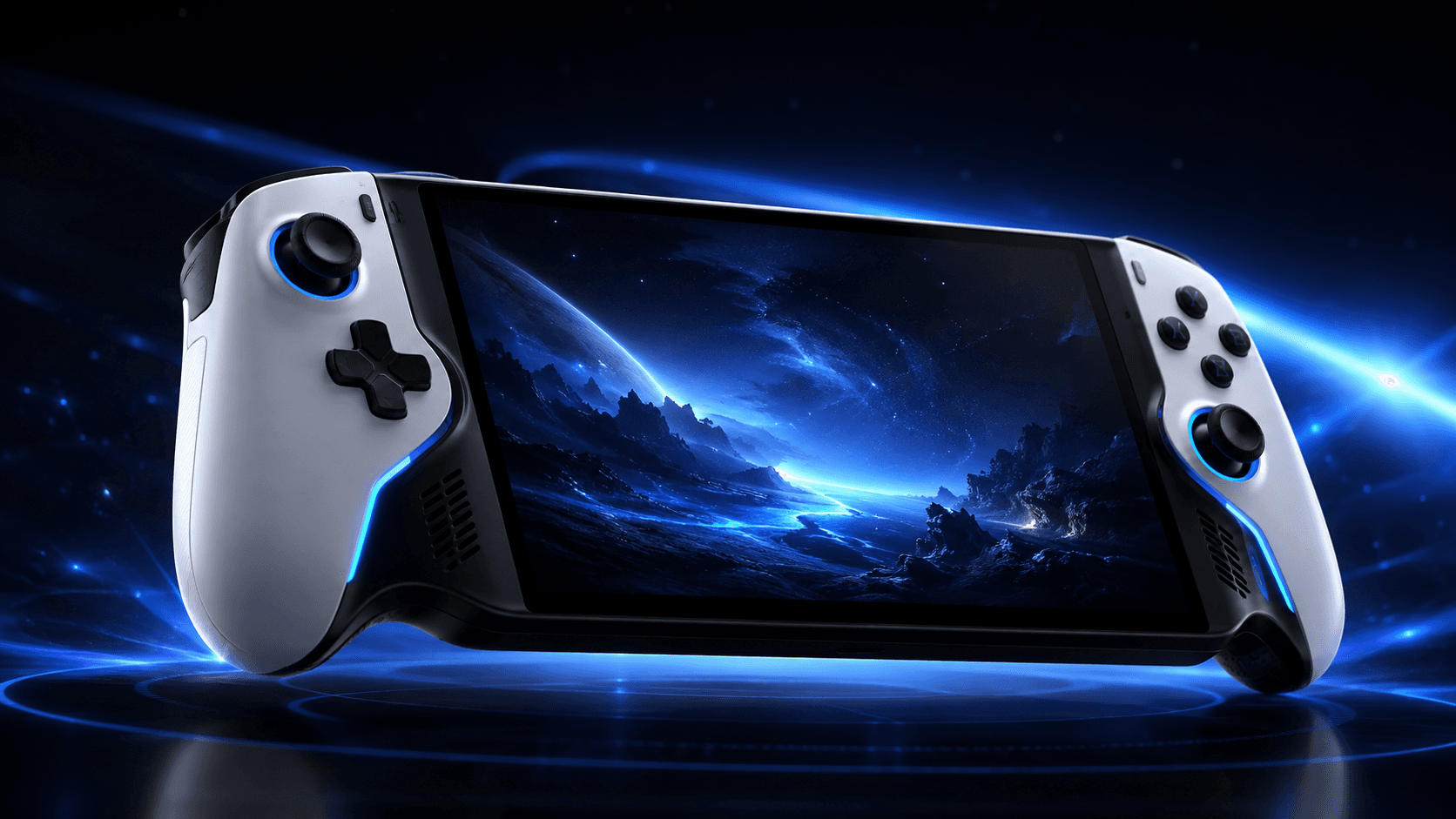
Sony could be preparing one of the biggest changes to the PlayStation hardware strategy in decades: a true portable PlayStation capable of running games locally rather than relying on Remote Play.
Often referred to online as the PS6 Portable, PS6 handheld, or by the leaked codename Canis, the device has yet to be officially announced by Sony. However, the idea is considerably more credible than a typical console rumour.
Bloomberg reported back in November 2024 that Sony was in the early stages of developing a portable console capable of playing PlayStation 5 games. Since then, hardware leaks have painted a surprisingly detailed picture of a handheld built around next-generation AMD technology, with alleged support for PS4 and PS5 games, a touchscreen, expandable storage and even a Nintendo Switch-style docked mode.
If the reports ultimately prove accurate, Sony's next generation may therefore consist of more than simply a traditional living-room PlayStation 6.
There could be a much broader PS6 ecosystem in which players move between a powerful home console and a genuinely portable PlayStation.
Here is everything currently known — and everything that remains speculation — about the possible PS6 Portable.
Is the PS6 Portable Actually Real?
Sony has not officially announced a PS6 Portable.
That distinction is important.
There is no confirmed product name, price, specification sheet, release date or design from Sony Interactive Entertainment.
However, there are two significant strands of reporting supporting the idea that Sony is seriously interested in another dedicated handheld.
The strongest independent report came from Bloomberg in November 2024. Citing people familiar with Sony's plans, Bloomberg reported that the company was in the early stages of creating a portable console capable of playing PS5 games on the move. Unlike PlayStation Portal's original Remote Play model, this would be a device capable of running games itself. Bloomberg's original report on Sony's portable PlayStation development
The report also stressed that the hardware was years away and Sony could still decide against releasing it.
That is significant because subsequent leaks concerning Project Canis broadly fit the same concept: an AMD-powered PlayStation handheld designed to run console-class PlayStation software locally.
The Verge independently covered Bloomberg's reporting at the time, describing the planned machine as a native handheld rather than simply another streaming accessory. The Verge's coverage of Sony's reported handheld plans
The evidence is therefore stronger than somebody simply claiming that "Sony is making a PSP 3."
But until Sony formally reveals the device, Canis remains an unconfirmed product.
What Is Project Canis?
Canis is the codename frequently associated with Sony's rumoured next-generation portable hardware.
It has appeared alongside Orion, the name used in leaks for the main PlayStation 6 console.
We explain the relationship between the two machines in our guide to PS6 Orion, including the latest reported architecture and performance targets. What Is PS6 Orion?
Rather than being designed as another PlayStation Portal, Canis is reportedly a complete gaming system with its own AMD processor and graphics hardware.
That difference completely changes what a future PlayStation handheld could be.
PlayStation Portal began life primarily as a Remote Play device: the game itself ran on a PS5 and the resulting image was streamed to the Portal.
A Canis-based handheld would instead potentially run compatible games directly on the portable hardware.
That could mean taking a substantial portion of your PlayStation library outside your home without needing your PS6 or PS5 to render the game remotely.
Rumoured PS6 Portable Specifications
The most detailed hardware claims have come through YouTube channel Moore's Law Is Dead and have subsequently been covered by publications including Digital Trends.
The currently circulated Canis configuration reportedly uses a custom AMD system-on-chip built on a 3nm manufacturing process.
The alleged CPU configuration consists of four Zen 6c gaming cores alongside two lower-power Zen 6 cores, giving the chip six CPU cores in total.
Those additional low-power cores could potentially handle operating-system and background tasks while leaving the four main cores available to games.
Graphics are reportedly provided by a 16 Compute Unit RDNA 5-class integrated GPU.
According to the leak, GPU speeds could operate at approximately 1.2GHz in portable mode and rise to roughly 1.65GHz when docked.
The system is also claimed to use a 192-bit LPDDR5X memory controller, with leaked technical specifications indicating support for considerably more memory than Sony would necessarily install in a retail model.
Some reports have suggested 24GB could be a realistic configuration, although figures ranging considerably higher have circulated.
None of those specifications have been confirmed by Sony or AMD.
Digital Trends' breakdown of the leak also mentions a touchscreen, microSD expansion, haptic feedback and dual microphones. Digital Trends' breakdown of the leaked PS6 handheld specifications
For comparison, our full PS6 specifications guide tracks the much more powerful hardware currently being rumoured for Sony's primary next-generation home console. PS6 Specs, Rumours and Hardware Guide
PS6 Portable Rumoured Hardware at a Glance
The current leaks describe a machine built around a roughly 135mm² 3nm AMD APU, with four Zen 6c game-focused CPU cores, two additional low-power Zen 6 cores, 16 RDNA 5 Compute Units and a 192-bit LPDDR5X memory interface.
Graphics clocks have been reported at approximately 1.2GHz while handheld and 1.65GHz while docked.
Other alleged hardware includes a touchscreen, haptic feedback, dual microphones, USB-C video output, microSD storage expansion and potentially an M.2 SSD slot.
Backward compatibility with PS4 and PS5 software has also repeatedly appeared in the leaked information.
Again, these are reported development specifications rather than final Sony specifications. Hardware can change substantially before manufacturing begins.
How Powerful Could the PS6 Portable Be?
This is where Canis becomes particularly interesting.
A future handheld does not need to match the full PS6 console's raw performance to run versions of the same games.
Modern reconstruction, dynamic resolution, variable graphics settings and machine-learning upscaling make it possible for developers to target very different performance levels using broadly compatible architecture.
According to the leaked targets, Canis could deliver roughly 55–75% of the base PS5's rasterisation performance when docked, depending on workload and final clock speeds.
Ray-tracing performance could potentially compare much more favourably because several generations of AMD graphics architecture separate the PS5's RDNA 2-derived GPU from the reported next-generation RDNA 5 architecture.
The more important question therefore may not be whether Canis can match a PS5 teraflop-for-teraflop.
It is whether Sony can make PS5 and eventually PS6 games scale efficiently to it.
That could be achieved through lower internal resolutions, reduced graphics settings, AI-assisted reconstruction and specialised handheld performance profiles.
Sony already appears interested in software technologies that could make that type of scalable ecosystem increasingly practical.
Project Amethyst Could Be Crucial
Sony and AMD have been collaborating through Project Amethyst, a graphics technology initiative focused heavily on machine learning and improved ray tracing.
These technologies are potentially extremely important for portable hardware.
A handheld has strict limits on battery consumption, heat and chip size. Simply throwing more raw GPU power at the problem is inefficient.
Machine-learning reconstruction instead allows a game to be rendered internally at a lower resolution and intelligently reconstructed to produce a higher-quality output.
That is already the principle behind technologies such as PSSR on PS5 Pro.
Future generations could take the concept much further.
Our complete Project Amethyst guide examines the AMD and Sony technologies that could eventually form part of PlayStation 6. Project Amethyst Explained: The AMD Technology That Could Power PS6
If Canis exists, sophisticated reconstruction technology could be one of the reasons a relatively compact GPU is capable of running much more demanding software than its raw specifications initially suggest.
Could the PS6 Portable Run PS5 Games Natively?
Potentially, yes — and this may be one of the device's biggest selling points.
Bloomberg's original report specifically described Sony's project as a handheld capable of playing PlayStation 5 games.
Later Canis leaks have separately claimed compatibility with both PS4 and PS5 software.
That does not necessarily mean every PS5 title would automatically work perfectly.
Individual games could require patches, compatibility profiles or handheld-specific settings.
A PS5 title designed around the home console's CPU, GPU clocks and memory characteristics may not simply scale down without modification.
Nevertheless, retaining the same broad AMD/x86 architecture makes compatibility significantly more achievable than it would be if Sony moved to a completely different hardware platform.
Could It Play PS6 Games Too?
This is arguably the biggest unanswered question surrounding the entire device.
There are two possible strategies.
Sony could treat the machine essentially as a portable PS5-compatible device released during the PS6 generation, giving players access to an enormous existing PlayStation catalogue.
Alternatively, Sony could make Canis a genuine member of the PS6 hardware family and require developers to support both the main PS6 console and the lower-powered handheld.
The latter would be far more ambitious.
It would effectively mean Sony launching two performance targets for its next generation.
Developers could create a premium PS6 version targeting the powerful home console and a lower-resolution, lower-detail profile targeting Canis.
Digital Foundry has specifically discussed this question and noted that the precise software relationship between a Sony handheld and PS6 remains unclear. Digital Foundry discusses PS6 handheld compatibility
This is therefore one area where claims that the handheld will simply "run every PS6 game" should currently be treated cautiously.
PlayGo and a Possible Lower-Power PlayStation Profile
There is another interesting piece of the puzzle.
Sony's PlayGo technology and development tools include mechanisms that could help games distribute different assets depending on the hardware profile being used.
A reported Power Saver Mode has attracted particular interest because developers could theoretically optimise software around lower power limits.
That does not prove a portable PS6 exists.
However, it demonstrates why a shared PlayStation software ecosystem could be technically possible.
We examine the system and its potential next-generation implications in our PlayStation PlayGo explained feature. PlayStation PlayGo Explained and Why It Matters for PS6
Instead of building an entirely separate portable edition of every game, developers could potentially distribute lower-resolution textures or alter rendering targets depending on whether software is running on Orion or a lower-powered Canis device.
PS6 Portable Could Have a Docked Mode
One of the most intriguing Canis leaks is USB-C display output and a dedicated higher-performance docked operating mode.
That immediately invites comparisons with Nintendo Switch.
Rather than simply being a PlayStation you occasionally take outside, the handheld could theoretically connect to a television and increase its graphics clock while plugged into external power.
The leaked figures suggest approximately 1.2GHz graphics clocks in handheld mode and around 1.65GHz in docked mode.
A dock would not magically give the system additional Compute Units or turn it into the full PS6.
But removing battery restrictions and allowing greater power consumption could provide higher resolution, more stable frame rates or improved visual settings while connected to a television.
If true, Sony would effectively be entering the hybrid-console market that Nintendo popularised with Switch.
PS6 Portable vs PlayStation Portal
It would be easy to consider the PS6 Portable a successor to PlayStation Portal, but the two concepts are fundamentally different.
Portal primarily extends the existing PlayStation ecosystem through streaming.
A genuine handheld PlayStation contains the hardware needed to execute games locally.
That means a Canis-style machine could theoretically be used on a plane, train or anywhere else without maintaining a constant high-quality connection to another console.
Streaming would almost certainly remain useful, however.
A future PlayStation portable could potentially support three different ways of playing: locally rendered games, Remote Play from a home PlayStation and cloud-streamed titles through PlayStation Plus.
That combination would make it significantly more versatile than either a traditional handheld or the original Portal concept.
PS6 Portable vs Nintendo Switch 2
Nintendo is the obvious competitor.
Nintendo demonstrated with Switch that millions of players value the ability to move seamlessly between handheld and television gaming.
Sony would approach that market from a very different direction.
Nintendo's strength is its exclusive software, highly efficient hardware and accessible hybrid design.
Sony could instead leverage the huge existing PS4/PS5 digital ecosystem, high-end third-party titles and its investment in AMD technology.
A native PlayStation handheld capable of running games already owned on PSN could immediately have a substantial catalogue without requiring Sony to build another Vita-style software ecosystem from scratch.
That distinction could be critical.
Sony Cannot Afford to Repeat the PS Vita Problem
Sony has already produced two major dedicated handheld platforms.
The PlayStation Portable became a major success, but its successor, PlayStation Vita, never achieved comparable mainstream adoption.
One of Vita's biggest strategic problems was that it ultimately depended on developers supporting another separate PlayStation platform.
A modern handheld sharing technology and software with PS5 and PS6 could avoid much of that fragmentation.
Sony would not necessarily need developers to make "Canis games."
It could instead ask them to make PlayStation games capable of scaling across different hardware profiles.
That is much closer to the way PC gaming works and increasingly resembles Microsoft's broader strategy across Xbox consoles, PCs and handheld hardware.
Backward Compatibility Could Be the Killer Feature
Backward compatibility could determine whether a PS6 Portable immediately feels essential or merely interesting.
The leaked Canis specifications repeatedly claim support for PS4 and PS5 games.
If Sony can deliver access to users' existing digital libraries, someone buying the handheld could potentially begin with hundreds of compatible games rather than waiting years for a dedicated portable catalogue to develop.
The challenge would be physical media.
A compact handheld obviously isn't expected to contain a full-size Blu-ray drive.
Players who primarily own PS4 or PS5 games on disc would therefore need some mechanism for proving ownership if Sony wanted those libraries to transfer.
That is not currently known.
Physical versus digital ownership is likely to become an increasingly important issue across the entire PS6 generation.
Storage: microSD and M.2 Could Be Huge
Leaks claiming both microSD and M.2 storage support are particularly interesting.
Console games are enormous.
A portable device dependent entirely on expensive internal storage could quickly become frustrating.
MicroSD expansion would provide a convenient way of expanding capacity, while an M.2 slot could potentially allow much faster SSD storage for demanding PS5-class software.
Exactly how Sony would manage different storage speeds remains unknown.
It might permit older titles to run directly from slower removable storage while requiring newer PS5 or PS6 games to be installed on high-speed internal or M.2 storage.
The important point is that expandable storage appears to have been considered in the leaked design.
What Screen Could the PS6 Portable Use?
No reliable final display specification has emerged.
A touchscreen has repeatedly appeared in the leaks, but its resolution, size, refresh rate and panel technology remain unknown.
For a performance-focused handheld, something around 1080p would make considerably more sense than attempting to render modern games natively at 4K.
At typical handheld screen sizes, image reconstruction could also allow games rendered internally below native resolution to remain extremely sharp.
A 120Hz display would be attractive for responsive titles, while VRR could help smooth games operating at less consistent frame rates.
OLED would obviously be desirable, although panel cost will matter enormously if Sony wants the machine to remain competitively priced.
At this stage, any specific screen size or resolution should be regarded as speculation.
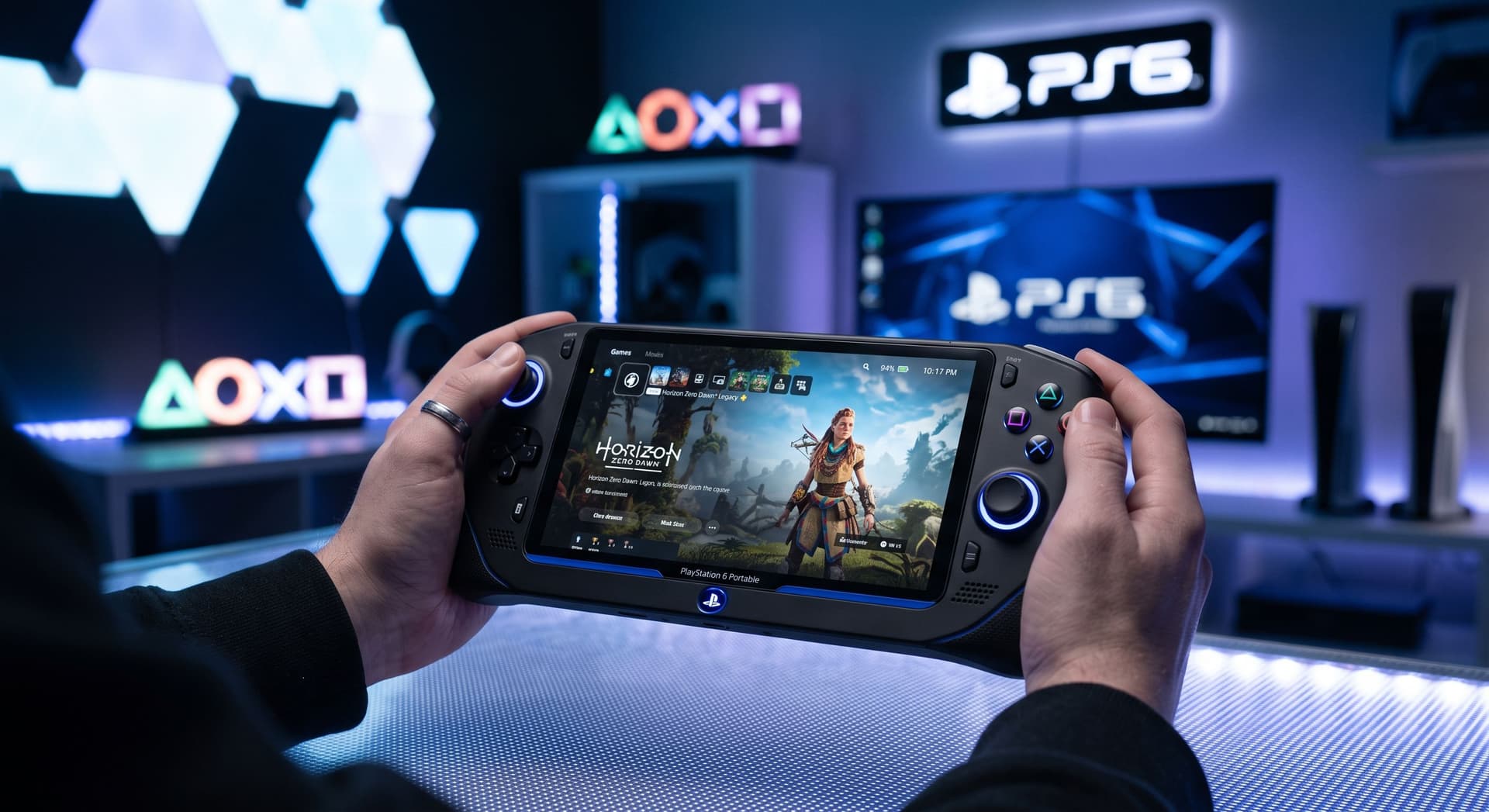
What Could the PS6 Portable Look Like?
No verified retail design has leaked.
Expectations largely centre around a larger screen positioned between two controller halves, similar in basic philosophy to PlayStation Portal, Steam Deck, ROG Ally and Nintendo Switch.
Sony would presumably want the controls to maintain the identity of DualSense.
Adaptive triggers and sophisticated haptics would therefore make sense, although both features consume additional power and space.
The final product could look very different from current concept renders circulating online.
You can see our broader exploration of Sony's possible next-generation industrial design in What Will the PS6 Look Like? PS6 Design Concepts: What Could PlayStation 6 Look Like?
How Much Could the PS6 Portable Cost?
There is currently no official price.
Some speculation has placed the machine somewhere around the $399–$499 range, but these figures are estimates rather than leaked Sony retail pricing.
The wider hardware market also makes pricing unusually difficult to predict.
Sony President and CEO Hiroki Totoki confirmed during the company's May 8, 2026 earnings Q&A that Sony had not decided the timing or pricing of its next-generation platforms.
Sony's official Q&A summary says memory prices are expected to remain elevated and supply conditions tight through 2027, with the company examining hardware cost reductions, sales strategies and even potential changes to its business model. Sony's official FY2025 earnings Q&A on next-generation hardware costs
That issue applies just as strongly to portable hardware.
RAM and storage represent a major portion of the manufacturing cost of a premium handheld.
A device equipped with 24GB or more of fast LPDDR memory, a custom AMD APU, NVMe storage, a high-quality display and sophisticated controls will not be inexpensive.
Our dedicated PS6 price guide tracks the same component pressures affecting Sony's home-console plans.
When Could the PS6 Portable Be Released?
There is no official release date.
Earlier Canis leaks suggested manufacturing could begin around mid-2027, followed by a possible release in late 2027 or thereafter.
However, the overall PS6 schedule has become considerably less certain.
Sony itself said in May 2026 that decisions regarding next-generation platform timing had not been made, while explicitly highlighting high memory prices and tight supply expected through 2027.
That makes it dangerous to treat a 2027 Canis launch as fixed.
The handheld could arrive alongside PS6, slightly before it, slightly afterwards, or potentially never reach retail if Sony decides the economics no longer make sense.
For the latest overall timeline, follow our continuously updated PS6 release date guide. PlayStation 6 Release Date: Everything We Know
We also track Sony's latest public comments in Is the PS6 Coming Soon? Is the PS6 Coming Soon? Latest Sony Update
Could PS6 and PS6 Portable Launch Together?
It is possible, but not confirmed.
Launching both simultaneously would give Sony a striking next-generation proposition: choose maximum performance with PS6 or choose mobility with a lower-powered portable machine.
There could also be strong commercial reasons to separate them.
Sony may prefer to establish the primary PS6 first, avoid splitting manufacturing capacity and introduce the handheld once the next-generation software ecosystem is mature.
Component availability will matter too.
Sony is already openly discussing the pressure caused by memory prices when considering its future hardware.
Producing millions of consoles and millions of memory-intensive handhelds simultaneously would amplify those pressures.
Would You Need a PS6 to Use the PS6 Portable?
If Bloomberg's original report and later Canis specifications accurately describe the final device, probably not.
The entire point of a native handheld is that it contains the processing hardware required to run games itself.
You might still receive benefits from owning both systems.
Save files could synchronise through PSN, games could potentially transfer between machines, and Remote Play could let the handheld access demanding titles that cannot run natively.
But unlike PlayStation Portal, a true Canis handheld should not inherently require a PS6 sitting elsewhere in your house.
That independence would arguably be the biggest reason for the product to exist.
Could Sony Sell PS6 and Portable Games as One Purchase?
This would be the ideal model.
A unified PlayStation Store could allow one purchase to provide whatever game data is appropriate for the hardware being used.
Buy a game once, play the highest-quality version on PS6, then continue the same save on the handheld.
Sony already operates within a digital ecosystem spanning multiple PlayStation generations, while technologies such as PlayGo provide mechanisms for intelligently managing game content.
Our guide to PlayStation PlayGo explores why this type of software delivery could become increasingly important. How PlayGo Could Help PS6 and a PlayStation Handheld Share Games
Whether Sony actually adopts universal PS6/handheld purchases remains unknown.
The Real Opportunity: One PlayStation Ecosystem
The most exciting possibility isn't simply that Sony could sell another handheld.
It is that PlayStation could stop treating portable and home gaming as separate ecosystems.
Imagine starting a game on PS6 connected to a 4K television, saving through PSN and instantly continuing the same game on a portable PlayStation later.
The home machine could deliver higher resolution, more advanced ray tracing and increased frame rates.
The portable could use reduced settings and sophisticated AI reconstruction to deliver the same underlying game at a lower power target.
Your trophies, friends, saves, purchases and PlayStation Plus membership would remain the same.
That is a much more compelling long-term strategy than asking developers to support a completely separate "PSP 3" platform.
What We Know, What Is Reported and What Is Still Speculation
Confirmed: Sony has not announced PlayStation 6 or a PS6 Portable. Sony has publicly discussed future gaming platforms and confirmed that, as of May 2026, decisions regarding next-generation timing and pricing had not been finalised.
Credibly reported: Bloomberg reported in November 2024 that Sony was developing a portable console intended to play PS5 games locally, although it warned the product remained years away and could still be cancelled.
Leaked but unconfirmed: The Canis codename, Zen 6c CPU configuration, RDNA 5 GPU, 16 Compute Units, 3nm process, docked mode, LPDDR5X memory configuration, touchscreen, microSD support and PS4/PS5 backward compatibility all come from unofficial hardware leaks rather than Sony announcements.
Pure speculation: Final branding such as "PS6 Portable", exact design, battery life, display specification, launch games, exact price and guaranteed compatibility with every PS6 game are not currently known.
That distinction should be remembered whenever new PS6 handheld rumours appear.
Why a PS6 Portable Makes Sense for Sony
The gaming hardware market has changed dramatically since PlayStation Vita disappeared.
Nintendo proved that handheld gaming never went away.
Valve demonstrated that players are willing to buy much larger and more powerful portable machines through Steam Deck.
Windows handhelds from ASUS, Lenovo and others have pushed portable performance further.
Meanwhile, Sony has spent years building a huge digital PlayStation library, strengthening PlayStation Network and investing in graphics technologies capable of scaling demanding games to different hardware.
A portable PlayStation today would therefore launch into a completely different market from Vita.
Most importantly, it wouldn't necessarily require its own software ecosystem.
If Sony can make existing PlayStation purchases, saves and subscriptions travel seamlessly between devices, the PS6 Portable would begin with a huge advantage.
The Biggest Challenges Sony Still Has to Solve
Sony still faces some enormous technical and commercial problems.
Battery life is one.
Cooling powerful AMD hardware inside a comfortable portable device is another.
Memory capacity and storage are increasingly expensive.
Developers will also resist another mandatory performance target if supporting a handheld significantly increases development and testing costs.
And Sony must decide what happens to customers with large physical PlayStation libraries if the portable is effectively digital-only.
Pricing could ultimately be the hardest problem of all.
A $399 handheld could be extraordinarily attractive.
A device approaching premium gaming-laptop territory would face a much tougher market.
Sony therefore has to balance performance, memory, battery capacity, display quality and manufacturing cost exceptionally carefully.
PS6 Portable FAQ
Is Sony making a PS6 Portable?
Sony has not announced one. However, Bloomberg reported that Sony was developing a native portable PlayStation capable of playing PS5 games, while later leaks describe next-generation handheld hardware codenamed Canis.
Is Project Canis the PS6 handheld?
Canis is the leaked codename associated with Sony's alleged next-generation handheld. Sony has never publicly confirmed that name.
Will the PS6 Portable play games without a PS6?
If the reported design reaches production, yes. Unlike PlayStation Portal's original streaming-focused approach, the proposed handheld contains its own CPU and GPU and would run compatible games locally.
Will PS6 Portable play PS5 games?
Bloomberg's original reporting specifically said Sony's project was being developed to play PS5 games. Canis leaks have subsequently claimed PS4 and PS5 backward compatibility. Final compatibility has not been confirmed.
Will it play PS6 games?
Possibly, but this remains one of the biggest unanswered questions. The shared AMD architecture could allow developers to target both devices, but Sony has not confirmed that every PS6 game would be required to support the handheld.
Can the PS6 Portable connect to a TV?
Leaks claim USB-C video output and separate handheld and docked GPU clock speeds, strongly suggesting that Sony has at least experimented with a docked mode. This remains unconfirmed.
How powerful will the PS6 Portable be?
Current leaks point to four Zen 6c gaming CPU cores, two low-power Zen 6 cores and a 16-CU RDNA 5 GPU. Reported docked rasterisation performance sits below the base PS5, although newer graphics architecture and AI reconstruction could make direct comparisons misleading.
How much will the PS6 Portable cost?
Sony has announced no price. Estimates around $399–$499 have circulated, but rising memory and component costs make any current retail-price prediction highly speculative.
When will the PS6 Portable come out?
There is no confirmed release date. Leaked plans mentioned manufacturing beginning in 2027, but Sony has since publicly confirmed that the timing of its next-generation platforms remains undecided.
Final Thoughts: PS6 Portable Could Be Sony's Most Important New Hardware in Years
The possibility of a PS6 Portable is much more interesting than simply reviving the PSP name.
If the strongest reports and leaks are pointing in the right direction, Sony appears to be exploring something considerably more ambitious: a PlayStation ecosystem in which home and portable hardware share the same games, accounts, saves and underlying technology.
Bloomberg's reporting provides credible evidence that Sony has explored a native handheld capable of playing PS5 software. The later Canis leaks provide a potential technical explanation for how such a product could evolve into Sony's next generation.
But the final warning is equally important.
Sony has not announced the PS6 Portable.
Its final specifications could change significantly. Its release window could move. Its software strategy remains uncertain. Sony could even cancel the project before consumers ever see it.
That uncertainty has only increased as rising component costs complicate Sony's next-generation plans. The company itself confirmed that timing and pricing decisions for future PlayStation platforms had not been finalised and that it was considering everything from reducing hardware costs to changing how future products are sold.
For now, Canis is one of the most credible and fascinating pieces of the wider PS6 puzzle.
If Sony gets it right, the next PlayStation generation might not be defined solely by how powerful the box underneath your television becomes.
It could be the generation where your full PlayStation experience finally goes wherever you do.