PS6 Graphics Roadmap Gets Its First QSSR Test
Sony has moved Project Amethyst out of the research lab and onto the standard PS5. Quick Spectral Super Resolution, or QSSR, is a new AI-guided upscaling library designed to improve image detail and stability without the dedicated machine-learning hardware found in PS5 Pro.
That makes QSSR more than a late-generation PS5 upgrade. It is the first public demonstration of Sony and AMD scaling their neural graphics work across two very different console performance tiers, giving us a practical clue about how the broader PS6 graphics roadmap could be built.
The distinction matters: Sony has not confirmed QSSR, PSSR or any named upscaler for PS6. What it has confirmed is that QSSR came from Project Amethyst, the same long-term Sony–AMD collaboration expected to shape future PlayStation graphics technology.
What Sony Actually Announced
In its official QSSR announcement, Sony describes QSSR as a new performance tier of AI upscaling. It uses a streamlined neural-network architecture and a hand-tuned implementation intended to maximise performance on the standard PS5.
Sony says PSSR remains its highest-quality option on PS5 Pro. QSSR instead targets the much larger base-PS5 audience, improving fine detail and temporal stability while working within a tighter compute budget.
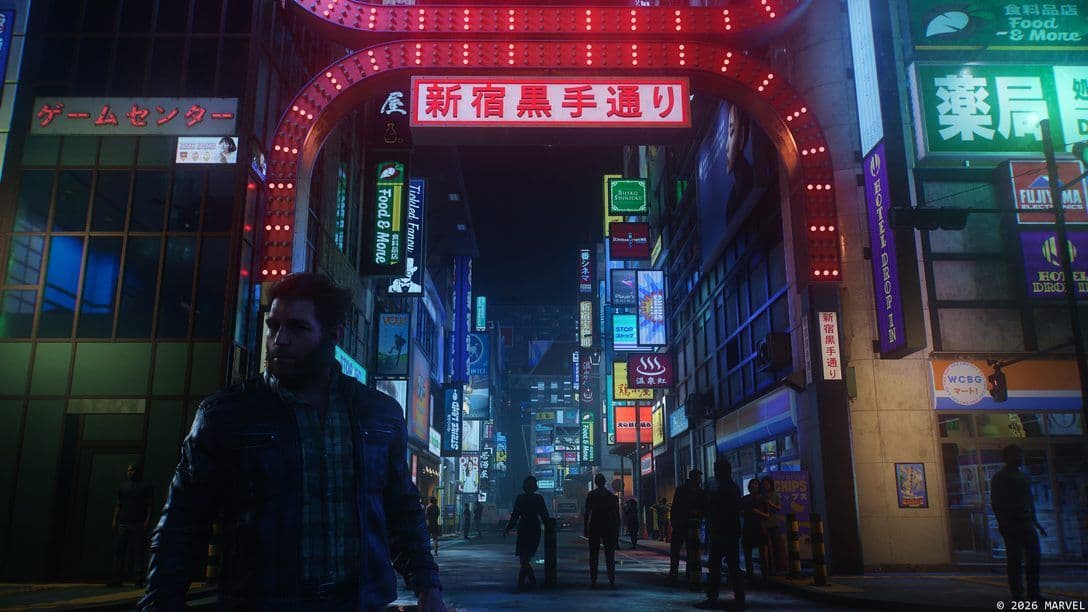
Marvel’s Wolverine and Ghost of Yōtei received the first QSSR patches on 1 October 2026. Sony is also offering the library broadly to PlayStation developers, so adoption is not restricted to Insomniac Games and Sucker Punch Productions.
How QSSR Works Around Base PS5 Limits
The original PS5 was not designed around a dedicated neural-processing block. That prevents it from running the same PSSR workload used by PS5 Pro without an unacceptable performance cost, so Sony created a smaller model rather than simply porting PSSR unchanged.
According to Digital Foundry’s technical analysis, QSSR primarily works with FP16 arithmetic on the standard PS5. PS5 Pro can lean on dedicated machine-learning hardware and lower-precision INT8 operations, giving PSSR considerably more specialised acceleration.
This is why QSSR should be viewed as a sibling to PSSR, not a renamed version of it. Both reconstruct a cleaner output from a lower-resolution image, but each model is balanced around a different hardware budget and output target.
Early Results: Better Clarity, Real Trade-Offs
In Marvel’s Wolverine, Digital Foundry measured QSSR reconstructing an image from roughly 864p to 1440p. The added processing cost was around 1.5–1.8 milliseconds per frame compared with Insomniac’s previous temporal solution, producing an eight-to-ten-frame-per-second difference in an unlocked test.
That cost does not make QSSR unusable. In a fixed 60fps mode, dynamic resolution can move the internal resolution to preserve the frame-rate target. The result is a trade: the reconstruction step consumes more frame time, but can deliver a more stable and detailed final image.
A 2160p output proved substantially harder, with the measured QSSR cost rising to about 4.4 milliseconds. The early evidence therefore points to 1440p-class output as the technology’s natural territory on base PS5, rather than the 4K presentation commonly targeted by PSSR on PS5 Pro.
Ghost of Yōtei Shows the Other Side
Ghost of Yōtei is useful because its existing FSR-based presentation was already stronger than the older reconstruction method replaced in Wolverine. QSSR still improved fine vegetation, character detail and stability in motion, but the difference was less dramatic.
Digital Foundry found broadly similar performance between QSSR and the game’s existing FSR 3 route in an unlocked performance test. That suggests QSSR’s value will vary by game: replacing a weak temporal upscaler can produce an obvious upgrade, while replacing a competent modern solution may deliver a smaller refinement.
It also underlines why image reconstruction cannot be judged from a single paused frame. Temporal stability, disocclusion, foliage shimmer and fine detail during camera movement are often more important than static sharpness.
QSSR Is Not PSSR—and It Is Not PS6
QSSR does not give the standard PS5 the PS5 Pro’s GPU, memory bandwidth or dedicated machine-learning acceleration. It cannot erase the hardware gap, and Sony is not presenting it as a replacement for PSSR.
The same caution applies to PS6. Sony has not announced the console’s neural hardware, output targets or reconstruction library, while reported specifications remain unconfirmed. Our PS6 versus PS5 Pro comparison separates those reports from Sony’s public technology work.
What QSSR confirms is narrower but still important: Project Amethyst is already producing deployable technology, Sony is creating multiple performance tiers, and developers can integrate those tiers through a shared PlayStation graphics direction.
Why This Matters for PS6 Graphics
A future console benefits from an upscaler only if studios can adopt it reliably. By shipping QSSR across two first-party games and then opening it to all PlayStation developers, Sony can gather years of practical feedback before its next hardware generation arrives.
That feedback includes the awkward parts: low-resolution inputs, particle-heavy scenes, thin geometry, foliage, rapid motion and the frame-time cost of reconstruction. Those lessons can feed a more capable future model, while familiar tools may reduce the work required to move engines from PS5 to PS6.
QSSR also supports the idea that Sony’s next-generation strategy will not rest on raw raster performance alone. Our guide to FSR Next and PlayStation’s next upscaling stack explains why neural reconstruction, denoising and ray-tracing assistance could matter as much as traditional teraflop gains.
The reasonable inference is that PS6 hardware would pair a more advanced model with dedicated acceleration, allowing higher output resolutions or lower internal rendering costs. That is an inference from Sony’s current direction—not a confirmed PS6 specification.
What to Watch Next
The first test will be adoption. Sony has promised broad developer access, but it has not named the next wave of compatible games or said whether QSSR can be added universally through system software. Support still depends on game-level integration and patches.
The second test is whether third-party studios can reproduce the results seen in Sony’s first-party engines. Wider use will reveal how QSSR handles different motion-vector pipelines, post-processing stacks and dynamic-resolution systems.
Finally, watch how Sony combines reconstruction with future frame-generation work. Upscaling and generated frames solve different problems, and our PS6 frame-generation guide explains why responsiveness and base frame rate remain critical.
For now, QSSR is the clearest shipped evidence yet that Project Amethyst is becoming a family of practical PlayStation technologies. It does not reveal PS6, but it shows Sony testing the software foundation that could make the next console’s graphics leap more efficient.