PS6 HDMI 2.2: 4K 120Hz, 8K and VRR Explained
PS6 HDMI 2.2 support could give Sony’s next console far more display bandwidth, but it would not magically make every game run at native 8K or 240 frames per second. The connector can carry only what the console renders, and Sony has not announced the PlayStation 6 or its video-output specification.
HDMI 2.2 is nevertheless an important part of the next-generation picture. The standard raises the maximum link bandwidth to 96Gbps and expands support for high-resolution, high-refresh and high-colour-depth signals. This guide explains what that means, what PS5 already does and which PS6 expectations are realistic.
As of 16 September 2026, Sony has not confirmed HDMI 2.2, 8K output, a 4K/120fps target or any specific PS6 Variable Refresh Rate implementation. Our PS6 specifications guide lists HDMI 2.2 among reported features, but it is not an official specification.
The version number alone will not settle the question. HDMI standards contain optional capabilities, and manufacturers must state which bandwidths and features a device actually supports. The PS6 port, cable, television and software would all need to agree on the chosen mode.
PS5 and PS5 Pro Set the Current Baseline
PS5 introduced HDMI 2.1-class output with support for compatible 4K 120Hz displays, Variable Refresh Rate and Auto Low Latency Mode. Actual game performance varies: many titles use 30fps or 60fps modes, while selected competitive and performance modes can reach 120fps.
Sony’s official PS5 Pro page says compatible games can combine 4K output, ray tracing and frame rates up to 120fps. The wording matters. Output resolution, reconstructed image resolution and native rendering resolution are not necessarily the same.
PS5 Pro often uses PlayStation Spectral Super Resolution to reconstruct a sharper 4K image from a lower internal resolution. The same principle is likely to become more important next generation because smarter reconstruction can improve image quality without the enormous cost of rendering every pixel natively.
PS6 HDMI Fact-Check Table
| Feature | PS5 / PS5 Pro | PS6 status |
|---|---|---|
| Connector standard | HDMI 2.1-class output | Unconfirmed |
| 4K output | Confirmed | Expected, not announced |
| 120Hz and VRR | Supported in compatible games and displays | Unconfirmed |
| Feature | HDMI 2.2 capability | Does this confirm PS6 support? |
|---|---|---|
| Maximum bandwidth | Up to 96Gbps | No |
| High-refresh formats | Up to 4K/240Hz uncompressed | No |
| High-resolution formats | Up to 8K/60Hz uncompressed, plus higher specialist modes | No |
| Cable | Supported bandwidth | PS6 requirement |
|---|---|---|
| Ultra High Speed HDMI | Up to 48Gbps | Unknown; sufficient for current PS5 modes |
| Ultra96 HDMI | Up to 96Gbps | Needed only if PS6 uses modes beyond the older cable’s capacity |
What HDMI 2.2 Actually Adds
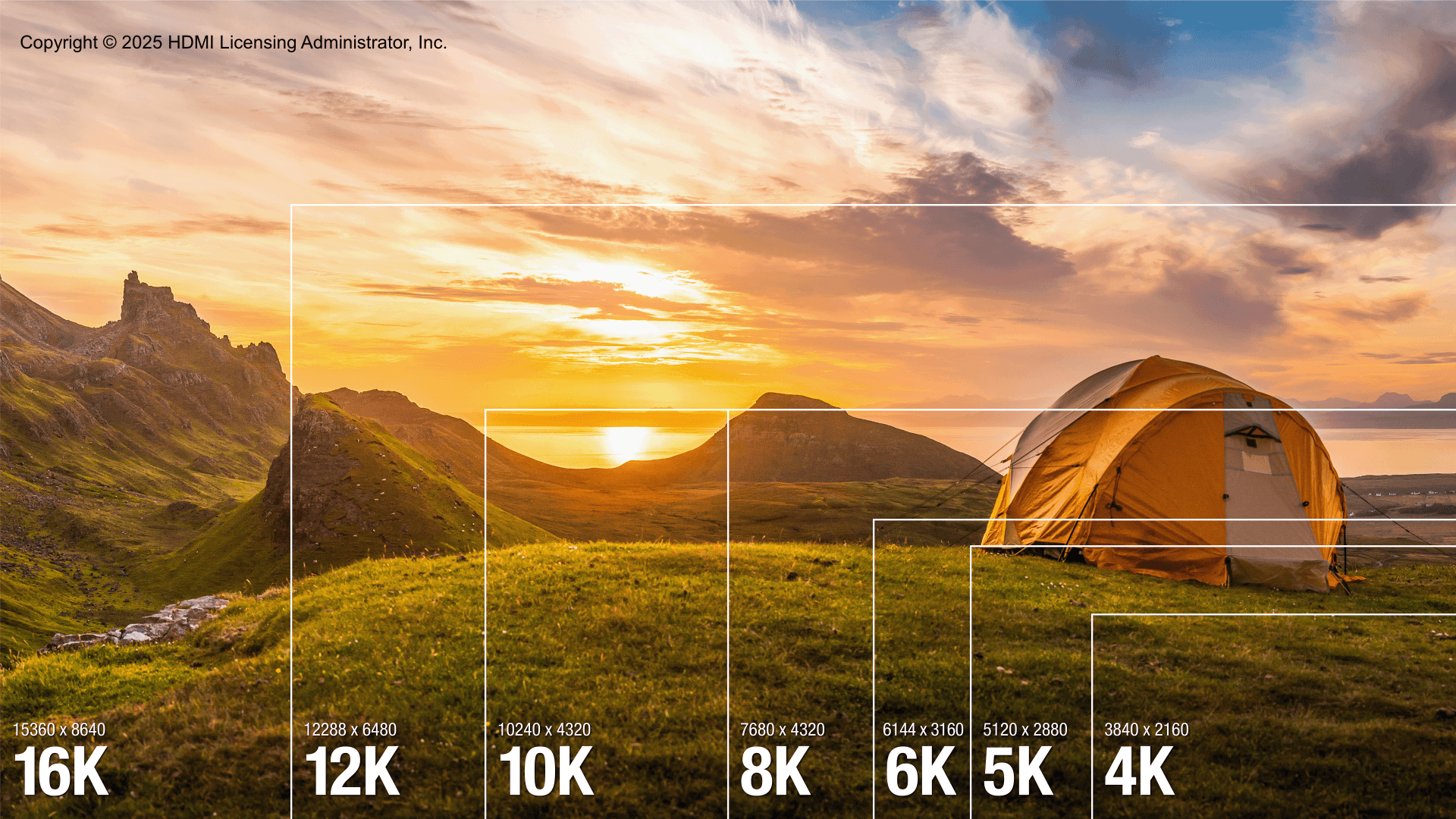
The official HDMI 2.2 specification overview describes up to 96Gbps of bandwidth, double HDMI 2.1’s 48Gbps ceiling. It supports uncompressed 4K/240Hz and 8K/60Hz signals with full 4:4:4 chroma at 10-bit or 12-bit colour, alongside still higher specialist resolution and refresh combinations.
That extra headroom can carry more frames, more pixels or greater colour precision without relying as heavily on chroma reduction or compression. For games, the most useful result may be cleaner high-refresh 4K output rather than headline 12K or 16K modes intended for specialised displays.
HDMI 2.2 also introduces the Ultra96 cable category and a Latency Indication Protocol designed to improve audio-video synchronisation through systems containing receivers or soundbars. Existing gaming features including VRR, ALLM and Quick Frame Transport remain part of the broader standard.
4K at 120fps Matters More Than 4K at 240fps
A 240Hz output option is technically impressive, but rendering a graphically complex console game at 240fps leaves only about 4.17 milliseconds for each frame. At 120fps the budget is approximately 8.33ms; at 60fps it is 16.67ms. Higher frame rates rapidly reduce the time available for simulation, lighting, animation and ray tracing.
Competitive games with simplified visuals may use 144Hz, 165Hz or 240Hz modes if PS6 hardware and software support them. Large cinematic games are more likely to target 30fps, 40fps, 60fps or 120fps depending on visual settings. HDMI bandwidth does not remove those rendering limits.
The biggest practical PS6 gain would be fewer compromises at 4K-class output. Our PS6 graphics guide explains why stronger ray tracing, machine-learning reconstruction and steadier performance matter more than one maximum refresh-rate number.
Native 8K Is the Wrong PS6 Test
An 8K image contains four times as many pixels as 4K and sixteen times as many as 1080p. Rendering that workload natively consumes processing power that could instead improve lighting, geometry, animation, physics or frame rate. The benefit is also difficult to see on typical television sizes and viewing distances.
PS6 could still output an 8K signal for media, user-interface elements, screenshots or selected lightweight games. Machine-learning reconstruction may also create an 8K-class presentation from a lower internal resolution. None of those scenarios means demanding games will render natively at 8K.
The better question is whether PS6 can deliver a convincing high-resolution image while maintaining smooth performance and advanced lighting. The comparison between PS6 and PS5 Pro shows why reconstruction quality and frame-rate stability are better measures of progress.
VRR, HDR and Latency Could Deliver the Real Upgrade
Variable Refresh Rate synchronises the display with the console’s frame delivery, reducing tearing and making fluctuations feel smoother. A wider supported VRR range and reliable low-frame-rate compensation would improve more games than an 8K badge, although Sony has not confirmed either feature for PS6.
Higher bandwidth can also preserve richer HDR signals at demanding resolutions and refresh rates. That does not automatically improve a television’s brightness, contrast or colour volume, but it can prevent the connection from becoming the bottleneck when the console and panel support high-quality formats.
Project Amethyst may influence this pipeline before the signal reaches the HDMI port. Improved reconstruction and ray tracing could create better frames, while HDMI 2.2 would provide the transport capacity to deliver them to future displays.
Should You Upgrade Your Television for PS6?
Not yet. PS6 remains unannounced, its display features are unknown and HDMI 2.2 televisions are still evolving. Buying an expensive panel or Ultra96 cable today solely for a rumoured console could leave you paying early-adopter prices for bandwidth the final hardware does not use.
A quality HDMI 2.1 television with 4K, 120Hz, VRR, ALLM and strong HDR remains a sensible match for PS5 Pro and a credible starting point for PS6. Panel quality, input latency, local dimming or OLED performance can matter more than the version number printed on the box.
Wait for Sony to publish the PS6’s supported resolutions, refresh rates, bandwidth and cable requirements. HDMI 2.2 would give the console valuable headroom, but the real generational leap will come from the frames Sony’s hardware can create—not the theoretical maximum carried by the socket.