Xbox Disc-to-Digital Programme Starts 31 August for Insiders
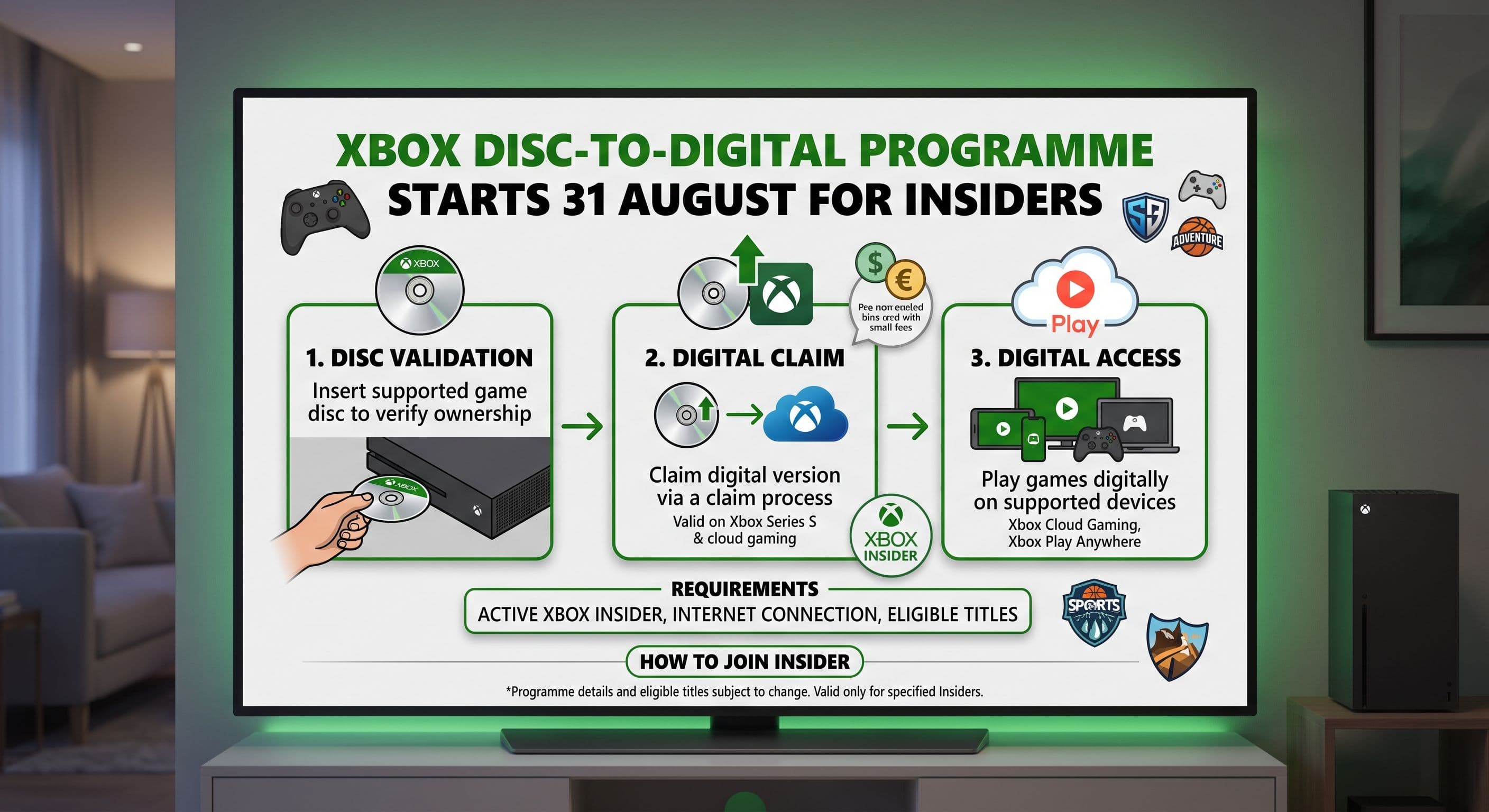
Microsoft has officially confirmed its long-awaited disc-to-digital programme, according to Digital Foundry, with the initiative opening to Xbox Insiders from 31 August. The scheme allows players to insert a supported Xbox One or Xbox Series disc and claim a permanent digital entitlement that remains tied to that physical copy. Once unlocked, the title can be launched without the disc present on consoles, on Windows PCs through Play Anywhere, and via cloud streaming. The announcement signals a major evolution in how Microsoft treats physical ownership as the industry tilts further toward pure digital distribution and subscription models.
The programme launches with thousands of eligible titles already in the catalogue, and Microsoft intends to keep adding more games over subsequent months. Critically, the digital licence travels with the disc rather than locking permanently to a single account. That design preserves the second-hand market: when a used copy is sold or traded, the entitlement moves with it. Sources close to the project frame the entire effort as strategic groundwork for an all-digital next-generation console known as Project Helix, especially as traditional disc-drive manufacturing grows scarcer and more costly to maintain at scale.
How the Disc-to-Digital Process Works
Eligible Xbox Insiders simply insert a supported disc into their console and follow an on-screen prompt that claims the matching digital licence. The entitlement is then permanently associated with that specific physical medium, not merely the user’s profile. After the claim succeeds, the disc can be removed and the game will still appear in the user’s library for offline or online play. Because the licence is portable with the disc, lending a game to a friend or selling it through a retailer continues to transfer full digital rights, a deliberate contrast with many earlier digital-only conversion schemes that stripped resale value.
Play Anywhere support means the same unlocked title becomes available on compatible Windows PCs without any additional purchase, while cloud streaming lets owners jump in from almost any device. The system therefore bridges three distinct play environments—console, PC and cloud—under a single ownership token derived from a physical purchase. Microsoft has stressed that the feature starts with a broad but not exhaustive list of Xbox One and Xbox Series titles; further catalogue expansions are expected once the Insider phase validates the backend infrastructure and anti-fraud measures around disc-linked entitlements.
Protecting Used Games in a Digital Age
One of the most closely watched design decisions is the decision to keep the digital entitlement bound to the disc itself. Earlier industry experiments often converted a physical purchase into an account-locked licence, effectively killing the second-hand market overnight. Microsoft’s approach deliberately avoids that outcome. Retailers, charity shops and private sellers can continue trading discs knowing the buyer receives both the plastic and the full digital rights. For collectors and budget-conscious players this preserves a vital economic loop that has underpinned console gaming for decades.
The model also reduces friction for households that share games among family members or rotate titles through a local network of friends. Because the licence follows the disc, there is no need for complicated family-sharing setups or temporary account log-ins. At the same time, the system still rewards original purchasers who prefer the convenience of digital installs and cloud access. Industry analysts see the dual benefit—convenience plus retained resale value—as a pragmatic compromise that softens the transition toward an eventual all-digital hardware generation without alienating the physical-media audience still active today.
Project Helix and the All-Digital Horizon
Multiple sources indicate the disc-to-digital programme is more than a consumer convenience feature; it is preparatory infrastructure for Project Helix, Microsoft’s next-generation Xbox hardware. That console is widely expected to launch without a disc drive as standard, reflecting both declining optical-drive availability and the company’s long-term push into Game Pass and cloud services. By giving current disc owners a clean migration path now, Microsoft reduces the risk of a backlash when physical media support eventually disappears from new hardware.
Declining disc-drive production capacity has already forced both major console makers to rethink physical strategies. Component shortages and falling demand for optical media make dedicated disc drives increasingly expensive to include. An official conversion path that still honours used-game economics gives Microsoft breathing room to phase out physical drives while retaining goodwill. The Insider launch on 31 August therefore functions as both a live stress test of the entitlement system and an early signal of the form factor players should expect from Helix when it eventually arrives.
Physical Media Strategy Timeline
| Company | Milestone | Timing | Status |
|---|---|---|---|
| Microsoft | Disc-to-Digital Insider launch | 31 August 2026 | Confirmed |
| Microsoft | Thousands of titles supported at launch | August 2026 | Confirmed |
| Microsoft | Project Helix all-digital console | Next generation | Projected |
| Sony | End of physical disc production | 2028 | Confirmed |
| Sony | Equivalent disc-to-digital programme | — | None announced |
Sony’s Contrasting Path to 2028
The Xbox announcement stands in sharp relief against Sony’s publicly stated plan to cease physical disc production entirely in 2028. Sony has so far offered no comparable disc-to-digital conversion path for PlayStation owners. Players who have amassed large physical libraries face an uncertain future once manufacturing ends and new hardware potentially ships without optical drives. The absence of a formal migration tool leaves open questions about long-term access, especially for titles that never received robust digital storefront support or that rely on disc-based authenticity checks.
Microsoft’s decision to preserve used-game liquidity while simultaneously enabling disc-free play therefore looks increasingly strategic. It positions Xbox as the platform still willing to honour the hybrid ownership model that many enthusiasts prefer. Sony’s quieter approach may reflect confidence in its digital storefront and PlayStation Plus ecosystem, yet it also risks frustrating collectors and value-focused buyers who continue to rely on physical copies. The divergence gives Microsoft a clear messaging advantage in the run-up to the next hardware cycle and could influence platform-switching decisions among physical-media loyalists.
What This Means for PS6
For PlayStation players watching the PS6 horizon, Microsoft’s disc-to-digital launch sharpens an already stark contrast in philosophy. Sony has confirmed it will end physical disc production in 2028 and has announced no equivalent conversion programme. That leaves PS6 architects with a strategic choice: either reverse course and introduce a late disc-to-digital scheme of their own, or double down on pure digital and subscription models while accepting possible library lock-out for physical owners. The Xbox move raises the competitive bar; any PS6 that ships without a clear migration story for existing disc collections risks appearing less player-friendly. British and European audiences, still heavily invested in physical retail and second-hand markets, will watch Sony’s response closely as the next generation approaches.